Adriano Ambrosi, Maria Teresa Castañeda, Alfredo de la Escosura-Muñiz, Arben Merkoçi.
Chapter 6 at “BIOSENSING USING NANOMATERIALS – BIONANO“, Edited by Arben Merkoçi, Published by Wiley-Interscience (2009)
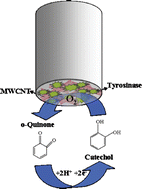
Improvement of the electrochemical detection of catechol by the use of a carbon nanotube based biosensor
Tyrosinase (Tyr) has been used frequently for the detection of phenolic compounds. The development of a biosensor based on this enzyme-integrated carbon nanotube (CNT) epoxy composite electrode (CNTECE) is described in order to perform measurements of catechol. The enzyme is immobilized into a matrix prepared by dispersion of multi-wall...

Controlling the electrochemical deposition of silver onto gold nanoparticles: Reducing interferences and increasing the sensitivity of magnetoimmuno assays
An electrocatalytical method induced by gold nanoparticles in order to improve the sensitivity of the magnetoimmunosensing technology is reported. Microparamagnetic beads as primary antibodies immobilization platforms and gold nanoparticles modified with secondary antibodies as high sensitive electrocatalytical labels are used. A...
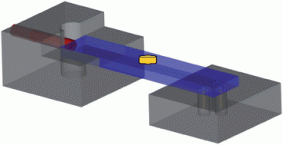
Lab-on-a-chip for ultrasensitive detection of carbofuran by enzymatic inhibition with replacement of enzyme using magnetic beads
In this paper an ultrasensitive method to determine toxicity due to pesticides in a glass lab-on-a-chip by means of enzymatic inhibition of acetylcholinesterase immobilised on magnetic beads is described. The reproducible insertion of a controlled amount of enzyme-coupled magnetic beads inside the chip channel and their immobilisation...
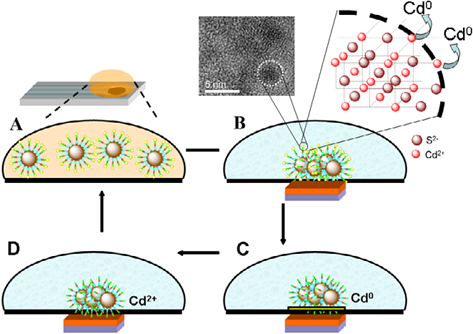
Direct electrochemical stripping detection of cystic fibrosis related DNA linked through cadmium sulphide quantum dots
Electrochemical detection of a cadmium sulfide quantum dots (CdS QDs)–DNA complex connected to paramagnetic microbeads (MB) was performed without the need for chemical dissolving. The method is based on dropping 20 µl of CdS QD–DNA–MB suspension on the surface of a screen-printed electrode. It is followed by magnetic collection...
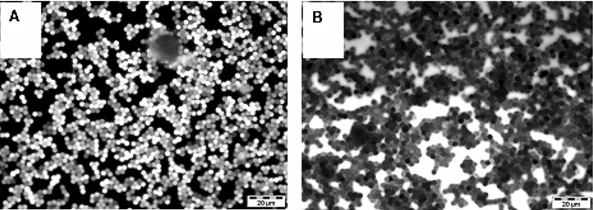
Permeability Improvement of Electropolymerized Polypyrrole Films in Water Using Magnetic Hydrophilic Microbeads
The electrochemical polymerization of polypyrrole films onto magnetically immobilized hydrophilic microbeads was carried out. Poly(pyrrole-pyrene)-microbeads coatings display thus higher permeability in water towards the diffusion of ferrocyanide than a pure poly(pyrrole-pyrene) film. In addition, the modulation of this permeability...