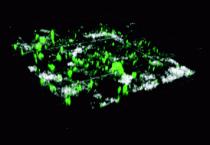
Structural characterization by confocal laser scanning microscopy and electrochemical study of multi-walled carbon nanotube tyrosinase matrix for phenol detection

Maria Guix, Briza Pérez-López, Melike Sahin, Mónica Roldán, Adriano Ambrosi, Arben Merkoci. Analyst 135, p. 1918-1925 (2010)
A novel visualization methodology based on the use of immunofluorescence and Confocal Laser Scanning Microscopy (CLSM) was used to quantify and visualize tyrosinase enzyme within a MWCNTs matrix immobilized onto carbon based screen-printed electrodes. CLSM was shown to be an extremely powerful technique which allowed a clear visualization...

Immunosensing using nanoparticles

Alfredo de la Escosura-Muñiz, Claudio Parolo, Arben Merkoçi. Materials Today, 13, p. 24-34 (2010)
Immunosensing technology is taking advantage of the lastest developments in materials science and inparticular from the nanomaterials field. Because of their unprecedented optical tunability as well as electrical and electrochemical qualities, we are seeing significant developments in the design of novel immunoassays; various conventional...

Gold nanoparticle-based electrochemical magnetoimmunosensor for rapid detection of anti-hepatitis B virus antibodies in human serum

Alfredo de la Escosura-Muñiz, Marisa Maltez-da Costa, Christian Sánchez-Espinel, Belén Díaz-Freitas, Jonathan Fernández-Suarez, África González-Fernández, Arben Merkoçi. Biosensors and Bioelectronics, 26 (4), p.1710-1714 (2010)
A sandwich immunoassay using magnetic beads as bioreaction platforms and AuNPs as electroactive labels for the electrochemical detection of human IgG antibodies anti-Hepatitis B surface antigen (HBsAg), is here presented as an alternative to the standard methods used in hospitals for the detection of human antibodies directed...

Nanoparticles-based strategies for DNA, protein and cell sensors

Arben Merkoçi. Biosensors and Bioelectronics, 26 (4), p. 1164-1177 (2010)
The need for novel biosensing systems has increased enormously in the last few years. In this context nanoparticles with special optical and electrochemical properties are bringing significant advantages in fields such as clinical analysis, environmental monitoring, food and safety/security control. Biosensor technology represents...

Enzyme entrapment by b-cyclodextrin electropolymerization onto carbon nanotube modified screen-printed electrode

Georgina Alarcón Ángeles, Maria Guix, Welter C. Silva, Maria Teresa Ramirez Silva, Manuel Eduardo Palomar Pardave, Mario A. Romero-Romo, Arben Merkoçi. Biosensors and Bioelectronics, 26 (4), 1768–1773 (2010)
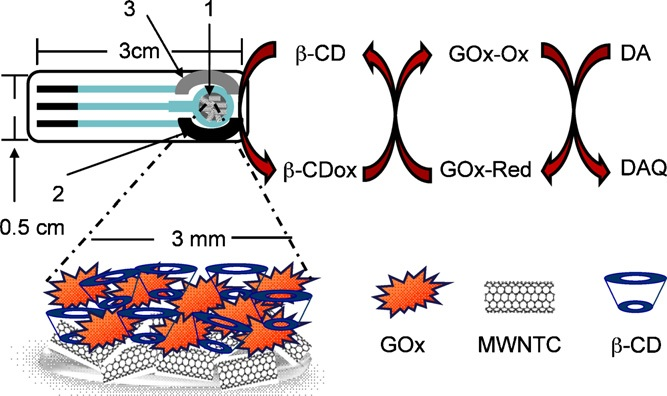
A novel enzyme entrapment approach based on an electropolymerization process utilizing multi-walled carbon nanotubes (MWCNT), β-cyclodextrin (β-CD) and glucose oxidase (GOx) is shown. Dopamine (DA) quantification is presented using a screen-printed electrode modified by electropolymerization of cyclodextrin with glucose oxidase,...

Electrochemical quantification of gold nanoparticles based on their catalytic properties on hydrogen formation: application in magneto immunoassays

Marisa Maltez-da Costa, Alfredo de la Escosura-Muñiz, Arben Merkoçi. Electrochem. Commun., 12, 1501-1504 (2010)
The catalytic ability of gold nanoparticles (AuNPs) toward the formation of H2 in the electrocatalyzed Hydrogen Evolution Reaction (HER) is thoroughly studied, using screen-printed carbon electrodes (SPCEs) as electrotransducers. The AuNPs on the surface of the SPCE, provide free electroactive sites to the protons present in the...

Nanoparticle based enhancement of electrochemical DNA hybridization signal using nanoporous electrodes

Alfredo de la Escosura-Muñiz, Arben Merkoçi. Chem. Commun., 46 (47), 9007-9009 (2010)
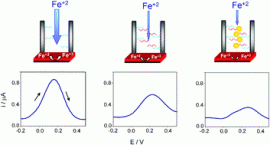
A novel nanoparticle-based enhanced methodology for the detection of ssDNA using nanoporous alumina filter membranes, containing pores of 200 nm in diameter, is reported. The blockage of the pores due to the hybridization is detected by measuring the decrease in the differential pulse voltammetric response of the [Fe(CN)6]4−/3−redoxindicator...

Compact Microcubic Structures Platform based on Self-Assembly Prussian Blue Nanoparticles with Highly Tuneable Conductivity

Welter C. Silva, Maria Guix, Georgina Alarcón Angeles, Arben Merkoçi. Phys. Chem. Chem. Phys., 12 (47), 15505 - 15511 (2010)
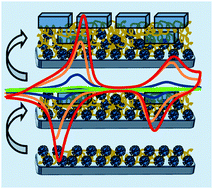
Control of molecular and supramolecular properties is used to obtain a new advanced hybrid material based on Prussian blue nanoparticles (PB NPs). This hybrid material is obtained through a self-assembled Layer-by-Layer (LbL) approach combining the advantageous features of β-cyclodextrin (β-CD) polysaccharides, PB NPs and poly(allylamine...

BIOSENSING USING NANOMATERIALS – BIONANO

Arben Merkoçi. Edited by Arben Merkoçi, Published by Wiley-Interscience, ISBN: 978-0-470-18309-0 (2009)
[Link to Table of Contents]

ICP-MS – a powerful technique for quantitative determination of gold nanoparticles without previous dissolving

Roza Allabashi, Wolfgang Stach, Alfredo de la Escosura-Muñiz, Leticia Liste Calleja, Arben Merkoçi. Journal of Nanoparticles Research, 11, p. 2003 (2009)
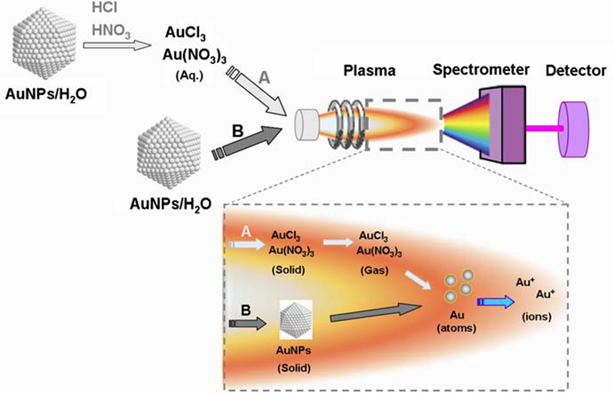
A direct and simple inductively coupled plasma mass spectroscopy (ICP-MS) method for the determination of gold nanoparticles (AuNP) with different particle sizes ranging from 5 to 20 nm and suspended in aqueous solutions is described. The results show no significant difference compared to the determination of the same AuNPs after...