Enhanced Gold Nanoparticle Based ELISA for a Breast Cancer Biomarker

Adriano Ambrosi, Federico Airò, Arben Merkoçi. Analytical Chemistry, 82, p. 1151-1156 (2010)
In this work, we developed an optical enzyme-linked immunosorbent assay (ELISA) immunoassay for the analysis of CA15-3 antigen, an important biomarker present in blood samples and useful for the follow-up of the medical treatment of breastcancer. Gold nanoparticles (AuNPs) were used as carriers of the signaling antibody anti-CA15-3-HRP...

Electrochemical detection of proteins using nanoparticles: applications to diagnostics

Alfredo de la Escosura-Muñiz, Arben Merkoçi. Expert Opinion on Medical Diagnostics 4(1), p. 21-37 (2010)
The detection of proteins is of crucial importance in the nowadays’ medicine for the early diagnosis of diseases. In this context, electrochemical immunoassays coupled with the recent advances in nanobiotechnology and nanomaterials (e.g. nanoparticles, NPs) offer new alternatives for clinical diagnostic procedures. Nanoparticles...

Use of Sequential Injection Analysis to construct a Potentiometric Electronic Tongue: Application to the Multidetermination of Heavy Metals

Aitor Mimendia, Andrey Legin, Arben Merkoçi, Manel del Valle. Sensors and Actuators B 146, p. 420–426 (2010)
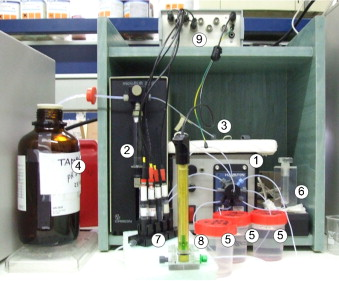
An automated potentiometric electronic tongue (ET) was developed for the quantitative determination of Cd2+, Cu2+ and Pb2+ heavy metal mixtures. The Sequential Injection Analysis (SIA) technique was used in order to automate the obtaining of input data. The combined response was modelled by means of Artificial Neural Networks (ANNs)....

Surface Characterizations of Mercury Based Electrodes with the Resulting Micro and Nano Amalgam Wires and Spheres Formations May Reveal Both Gained Sensitivity and Faced Non-Stability in Heavy Metal Detection

Gemma Aragay, Anna Puig-Font, Miquel Cadevall, Arben Merkoçi. Journal of Physical Chemistry C 114, p. 9049-9055 (2010)
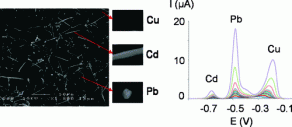
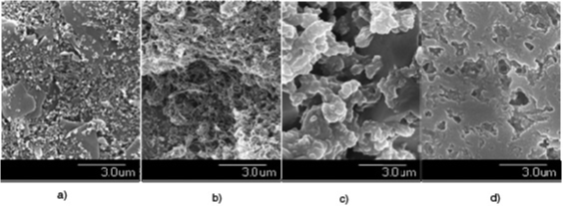
Surface characterizations of mercury-coated screen-printed electrodes with interest for electrochemical stripping analysis of heavy metals detection are presented. SEM images and microanalysis data of the working electrode surface show a homogeneous distribution of mercury film prior to sensor application in heavy metals detection...

Nanomaterials for Electroanalysis

Arben Merkoci, Adriano Ambrosi, Alfredo de la Escosura, Briza Pérez-López, Maria Guix, Marisa Maltez-da Costa, Sergio Marin. Chapter at Encyclopedia of Analytical Chemistry, DOI: 10.1002/9780470027318.a9077 (2010)
The emergence of nanotechnology and nanomaterials has opened up new horizons for the development of improved analytical devices. New synthesis, fabrication, and characterization methods offer the possibility to control the size, shape, and composition of nanometric-scale materials, thereby allowing exquisite control of their properties....

Stable and sensitive flow through monitoring of phenol using a carbon nanotube based screen printed biosensor

Georgina Alarcón Ángeles, Maria Guix, Adriano Ambrosi, Maria Teresa Ramirez Silva, Manuel Eduardo Palomar Pardave, Arben Merkoçi. Nanotechnology 21, p. 245502 (2010)
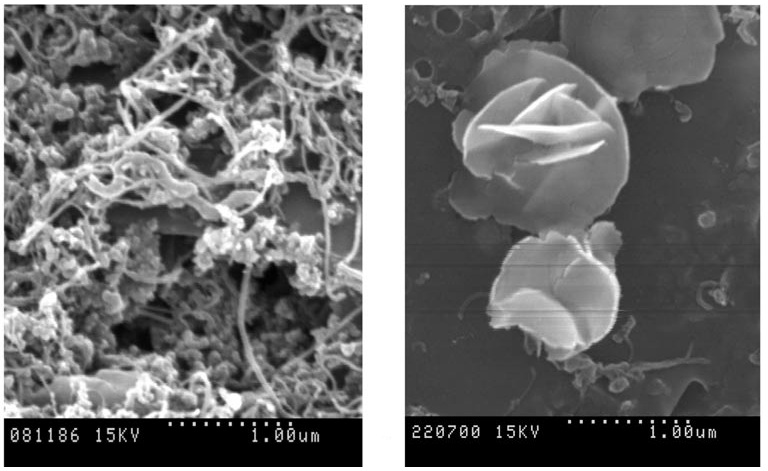
A stable and sensitive biosensor for phenol detection based on a screen printed electrode modified with tyrosinase, multiwall carbon nanotubes and glutaraldehyde is designed and applied in a flow injection analytical system. The proposed carbon nanotube matrix is easy to prepare and ensures a very good entrapment environment for...

Aminopyrazole based ligand induces gold nanoparticle formation and remains available for heavy metals sensing. A simple ‘mix and detect’ approach.

Gemma Aragay, Josefina Pons, Josep Ros, Arben Merkoçi. Langmuir 26, p. 10165-10170 (2010)
A novel way to synthesize gold nanoparticles based on the use of N-alkylaminopyrazole is shown. This ligand has a triple functionality: induces AuNPs formation, stabilizes the formed nanoparticles, and even remains available for an external coordination with heavy metal ions. The availability of N-alkylaminopyrazole ligands...

Bismuth film combined with screen-printed electrode as biosensing platform for phenol detection

Arben Merkoçi, Ulku Anik, Serdar Çevik, Meliha Çubukçu, Maria Guix. Electroanalysis, 22 (13), p.1429-1436 (2010)
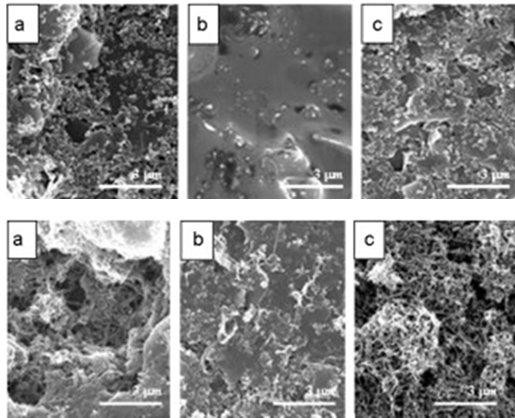
Mushroom tissue was immobilized onto plain screen printed electrode (SPE) and multiwalled carbon nanotube (MWCNT) modified SPE (SPE/MWCNT) via bismuth (Bi) deposition. By this way, SPE/Bi/Tissue and SPE/MWCNT/Bi/Tissue biosensors for phenol detection were obtained. UV-visible spectroscopy and SEM were utilized for explain the immobilization...

Label-free voltammetric immunosensor using a nanoporous membrane based platform

Alfredo de la Escosura-Muñiz, Arben Merkoçi. Electrochemistry Communications, 12, p. 859-863 (2010)
A novel device and methodology for the rapid and simple label-free electrochemical detection of proteins based on screen-printed carbon electrodes (SPCEs) modified with nanoporous Al2O3 membranes is reported. The nanoporous membranes are functionalized with antibodies and followed by the immunorecognition event that gives rise to...

Aptamers based electrochemical biosensor for protein detection using carbon nanotubes platforms

Pinar Kara, Alfredo de la Escosura-Muñiz, Marisa Maltez-da Costa, Maria Guix, Mehmet Ozsoz, Arben Merkoçi. Biosensors and Bioelectronics, 26 (4), p. 1715-1718 (2010)
A label-free bioelectronic detection of aptamer-thrombin interaction based on electrochemical impedance spectroscopy (EIS) technique is reported. Multiwalled carbon nanotubes (MWCNTs) were used as modifiers of screen-printed carbonelectrotransducers (SPCEs), showing improved characteristics compared to the bare SPCEs. 5’amino...