Nanomaterials and lab-on-a-chip technologies

Mariana Medina-Sánchez, Sandrine Miserere, Arben Merkoçi. Lab Chip, 2012,12, 1932-1943
Lab-on-a-chip (LOC) platforms have become important tools for sample analysis and treatment with interest for DNA, protein and cells studies or diagnostics due to benefits such as the reduced sample volume, low cost, portability and the possibility to build new analytical devices or be integrated into conventional ones. These...

Simple Forster resonance energy transfer evidence for the ultrahigh quantum dot quenching efficiency by graphene oxide compared to other carbon structures

Eden Morales-Narváez, Briza Pérez-López, Luis Baptista Pires, Arben Merkoçi. Carbon, 2012, 50, 2987-2993
Förster resonance energy transfer (FRET) entails the transfer of energy from a photoexcited energy donor to a close energy acceptor. In this regard, quantumdots (QDs), as donors, are quenched when they are next to an acceptor material. Graphite, carbon nanotubes (CNTs), carbon nanofibers (CNFs) and grapheneoxide (GO) were explored...

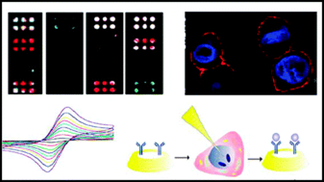
Nanoparticles for Proteins and Cells Detection. Novel Tools for Clinical Diagnostics

Alfredo de la Escosura-Muñiz, Arben Merkoçi. G.I.T. Laboratory Journal 1-2/2012. p. 21. 2012
Proteins and cells detection methodologies with interest for rapid and cost-effective diagnostics and based on nanoparticles and nanochannels, are described. The developed devices are based on the use of screen-printing technology, a mass production technology, with interest even to fulfill market needs. The described simple nanomaterial-based...

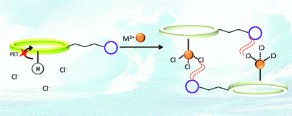
Rapid and high sensitive detection of mercury ions using a fluorescence based paper test strip with a N-alkylaminopyrazole ligand as receptor

Gemma Aragay, Helena Montón, Josefina Pons, Mercè Font-Bardía, Arben Merkoçi. Journal of Materials Chemistry, 22, 5978-5983. 2012
Easy-to-synthesize N-alkylaminopyrazole ligands are used in a proof-of-concept fluorescent sensor that can operate as a simple ‘paper test’ for rapid and highly sensitive mercury detection in water. A significant enhancement of fluorescence emission in aqueous media for the Hg2+ detection at concentrations lower than 0.1 ppb...

Medium Dependent Dual Turn-On/Turn-Off Fluorescence System for Heavy Metal Ions Sensing

Gemma Aragay, Georgina Alarcón, Josefina Pons, Mercè Font-Bardía, and Arben Merkoçi. J. Phys. Chem. C, 116 (2), 1987–1994. 2012
A dual turn-on/turn-off fluorescence sensing system based on N-alkylaminopyrazole ligands for heavy metal ions, where the response can be tuned upon medium change, is developed. The synthesis and characterization of ZnII, CdII and HgII complexes with two N-alkylaminopyrazole ligands, used as metal receptors, are first presented....

Bacterial Isolation by Lectin-Modified Microengines

Susana Campuzano, Jahir Orozco, Daniel Kagan, Maria Guix, Wei Gao, Sirilak Sattayasamitsathit, Jonathan C. Claussen, Arben Merkoci and Joseph Wang. Nano Letters, 12, 396−401. 2012.
New template-based self-propelled gold/nickel/polyaniline/platinum (Au/Ni/PANI/Pt) microtubular engines, functionalized with the Concanavalin A (ConA) lectin bioreceptor, are shown to be extremely useful for the rapid, real-time isolation of Escherichia coli (E. coli) bacteria from fuel-enhanced environmental, food, and clinical...

Bimetallic Nanowires as Electrocatalyst for Nonenzymatic Real Time Impedancimetric Detection of Glucose

Carmen C. Mayorga-Martinez , Maria Guix, Rossana E. Madrid, Arben Merkoçi. Chem. Commun., 48, 1686–1688. 2012
Gold-platinum nanowires are proposed as electrocatalysts in a real time nonenzymatic impedancimetric detection of glucose. The most important aspects for obtaining the bimetallic gold and platinum nanowires are described. The electrochemical behavior of the obtained platform toward electrocatalytic oxidation of glucose, including...

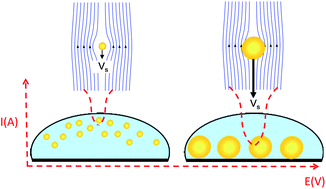
Size-dependent direct electrochemical detection of gold nanoparticles: application in magnetoimmunoassays

Alfredo de la Escosura-Muñiz, Claudio Parolo, Flavio Maran, Arben Merkoçi. Nanoscale, 3 (8), 3350 – 3356 (2011)
 The effect of the AuNPs size, ranging from 5 nm to 80 nm, on the electrochemical response of screen-printed carbon electrodes (SPCEs) used as electrochemical transducers is investigated for the first time. A simple hydrodynamic modelling and calculation at the nanoscale level is applied so as to find the effect of the size of AuNP...

Cancer detection using nanoparticle-based sensors

Maëlle Perfezou, Anthony Turner, Arben Merkoçi. Chemical Society Reviews, 41, 2606–2622 (2012)
This tutorial review surveys the latest achievements in the use of nanoparticles to detect cancer biomarkers and cancer cells with a focus on optical and electrochemical techniques. Nanoparticle based cancer diagnostics are becoming an increasingly relevant alternative to traditional techniques. Although some drawbacks exist in...

Recent Trends in Macro, Micro and Nanomaterials Based Tools and Strategies for Heavy Metals Detection

Gemma Aragay, Josefina Pons, Arben Merkoçi . Chemical Review, 111 (5), 3433-3458 (2011)
The presence of heavy metals in the air, soil and water is a global problem which means a growing threat to the environment and also to the human health. In response to this growing problem there is an increasing concern about the development of fast and effective techniques for in- situ monitoring of heavy metals. Here we summarize...