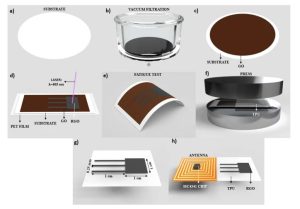
This study focuses on developing and characterizing flexible, low-resistance, laser-reduced graphene oxide (rGO) films, demonstrating a near-field communication (NFC) based electromyography (EMG) application. Graphene oxide (GO) was photothermally reduced on a nylon membrane using a 450 nm pulsed laser, resulting in a sheet resistance of 42.0 ± 0.4 Ω/sq, one of the lowest values reported under ambient conditions. The reduction process restored the sp² hybridization of carbon atoms on graphene, significantly enhancing the film’s conductivity to 152.2 ± 8.7 S/cm. The rGO films demonstrated remarkable mechanical and electrical stability, maintaining consistent conductivity after 2,000 bending cycles and under varying radii of curvature from 0.05 to 5.00 mm. Their mechanical stability and performance under deformation highlight their suitability for wearable bioelectronic devices, where flexibility and durability are critical. The films’ integration into an NFC-based EMG system also enabled precise muscle contraction measurements, confirming the material’s potential as a flexible electrode for advanced biomedical applications. The fabrication process is efficient and scalable, leveraging a laser-based reduction method that avoids the need for high-temperature or chemical treatments. These findings highlight laser-reduced rGO films as a promising material for next-generation flexible electronic applications, combining excellent conductivity, robustness, and adaptability to meet the demands of modern wearable technology. [Link to the article]