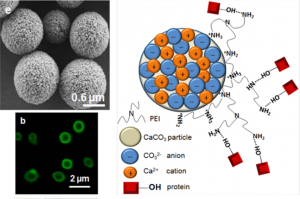
Nanostructured vaterite microparticles formation with high biofunctionalizing capacity for biosensing platforms using a water/organic solvent mixture with poly(ethyleneimine) (PEI) under sonication mixing conditions has been studied. A novel and effective polymorph discrimination is found with this system. Pure rhombohedra calcite phase has been observed using just water/organic mixed solvent systems. By increasing PEI concentration (from 4 to 8 mg/mL) a transformation from calcite and vaterite polymorphic mixture to only vaterite phase has been observed. The introduction of PEI as crystal growth modifier (CGM) in the reaction systems increases the vaterite fraction in the mineralization product and offers to vaterite microspheres a stability of up to 8 months. The PEI layer onto microparticle surface provides additional chemical activity to microparticles for further immobilizing of (bio)molecules via hydrogen bond formation between acid hydrogen in biomolecule and PEI´s nitrogen. The CaCO3-PEI microparticles here synthesized represent an interesting platform for the immobilization of a large range of biomolecules, from enzymes, antibodies, nucleic acids such as aptamers and DNA enzymes including other molecules with labile hydrogens. The obtained nanostructurated material could be useful as biosensing platform beside drug delivery, imaging and other applications.