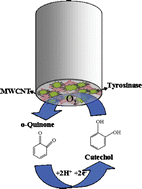
Tyrosinase (Tyr) has been used frequently for the detection of phenolic compounds. The development of a biosensor based on this enzyme-integrated carbon nanotube (CNT) epoxy composite electrode (CNTECE) is described in order to perform measurements of catechol. The enzyme is immobilized into a matrix prepared by dispersion of multi-wall CNT (MWCNT) inside the epoxy resin forming a CNT epoxy-biocomposite (CNTEC-Tyr). The use of CNT improves the electronic transference between the enzyme and the electrode surface. The modified electrode was characterized electrochemically by amperometric and voltammetric techniques. An applied potential of −200 mV vs.Ag/AgC1 applied to the biocomposite based electrode was found to be optimal for electrochemical reduction of the enzymatic reaction products (quinones). The biosensor modified with MWCNT is also compared with a tyrosinase biosensor based on a graphite epoxy-composite (GECE-Tyr) showing a sensitivity of 294 µA/mM cm2, a detection limit of 0.01 mM for a signal-to-noise ratio of 3 in a concentration range of 0.0–0.15 mM catechol with a response time of 20 s and an RSD of 8% (n = 3). The electrodes were stable for more than 24 h. A 90% increase of the signal indicated that the response is better with the biocomposite based on carbon nanotubes rather than with the graphite.